
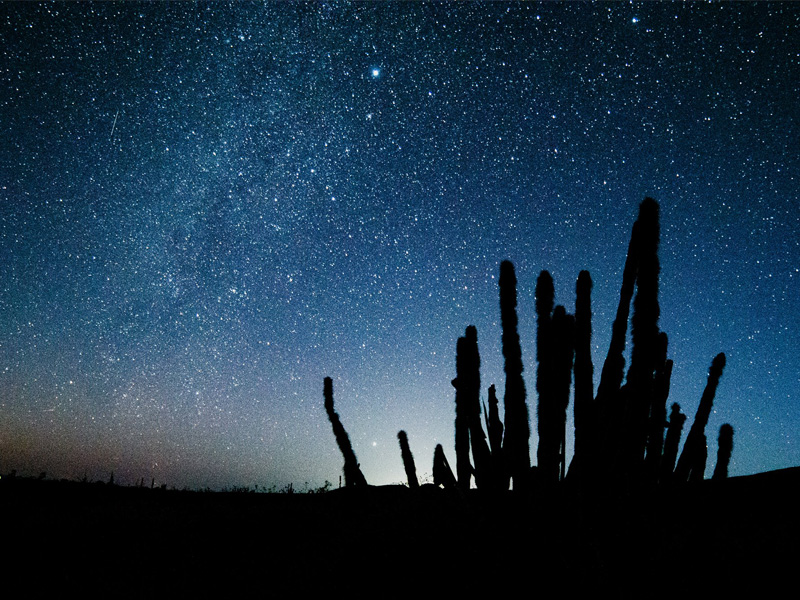
Giant cactus are among the most charismatic and iconic plant life forms on the planet, but many giant cactus species are threatened by the effects of climate change. The Dryland Plant Ecophysiology Lab and colleagues study the distinctive physiological features of giant cactus to better understand how they cope with long-term exposure to drought and heatwaves. A wide range of investigative tools are used to evaluate how these desert sentinels function and survive under stressful climate conditions.
Selected recent publications:
Wilder BT, Hultine KR, Dorshow WB, Vanderplank SE, Lopez BR, Medel-Narvaez A, Marvan M, Kindl K, Musgrave A, Macfarlan S, Ezcurra E. 2025. Plant responses to anomalous heat and drought events in the Sonoran Desert. Global Change Biology. https://doi.org/10.1111/gcb.70217.
Hultine KR, Hernández-Hernández T, Williams DG, Albeke SE, Tran N, Puente R, Larios E. 2023. Global change impacts on cacti (Cactaceae): current threats, challenges and conservation solutions. Annals of Botany 132: 671-683. https://doi.org/10.1093/aob/mcad040.
Recent funding sources:
- Binational Consortium for Regional Scientific Development and Innovation, funded by the National Council for Science and Technology, Mexico (Conacyt), and the University of Arizona’s Agnese Nelms Haury Program in Environment and Social Justice
- National Science Foundation. Integrative Organismal Systems program (Grant # 1818560)
Collaborating institutions:
University of Arizona, Northern Arizona University, University of Wyoming, Central Queensland University (Australia), Universidad Nacional Autónoma de México, Morton Arboretum
Photo: Senita cactus under the stars in the Pinacate Biosphere Reserve near Cono Rojo (Photo credit: Abby Hoffman).
