In 1939, a small group of passionate local citizens saw the need to conserve the beautiful desert environment. One was Swedish botanist Gustaf Starck, who found like-minded residents by posting a sign that read “Save the Desert.”
With the support of social influencers of the time such as Gertrude Divine Webster, the Garden’s presence grew. Nearly eight decades later, thanks to leadership and investments from many individuals, Desert Botanical Garden has blossomed from a dream into a living museum.
Historical Timeline
See how the Garden has grown during its history into a compelling attraction and desert conservation pioneer.
1939
The Garden opens its doors to the public.
1942
World War II brings most Garden activity to a halt. Arizona State Teachers College, now Arizona State University, provides administrative oversight while volunteers work to sustain the fragile collections on site.
1947
Gertrude Webster dies leaving her estate to support the Garden.
1952
Archer House is built and named in honor of Lou Ella Archer, a founding member who contributed time and talent to early fund drives.
1957
Under W. Taylor Marshall's leadership, the Garden’s collections increase from 1,000 specimens at the end of World War II to more than 18,000 specimens.
1961
The visitor center and gift shop are added.
1963
Galvin Parkway opens and provides direct access to the public.
1970
The new library is built to house a valuable donation of rare books and prints.
1977
The Docent Program is established as part of the Education Department to provide guided and informative tours.
1979
Luminarias welcomed 600 guests for the very first Las Noches de las Luminaries.
1983
The American Association of Museums accredits the Garden. Only 24 gardens have earned this distinction.
1985
Desert Botanical Garden becomes a charter member of the Center for Plant Conservation—a consortium of botanical gardens devoted to preserving rare flora of the United States.
1988
Plants and People of the Sonoran Desert Trail opens.
1992
The Garden secures a National Science Foundation grant to expand and upgrade the trail system.
2002
Garden completes a $17 million expansion, which includes a new entry and admissions area, gift shop, Dorrance Hall, a 400-seat reception hall and gallery, the Nina Mason Pulliam Research and Horticulture Center.
2008
$17.8 million campaign transforms old Cactus and Succulent Houses into Sybil. B Harrington Cactus and Succulent Galleries and opens Ottosen Entry Garden.
2009
Joy and Howard Berlin Agave Yucca Forest opens.
2010
Center for Desert Living Trail is refurbished.
2013
The Garden celebrates its 75th anniversary and launches The Saguaro Initiative, a fundraising campaign to invest in the future of the Garden.
2014
The Central Arizona Conservation Alliance is formed to study, protect and promote the Valley’s mountain park preserves.
2015
Spaces of Opportunity is a community initiative in south Phoenix working to transform a food desert to a food oasis through an incubator farm, family gardens and farmers market.
2015
The Virginia G. Piper Desert Terrace Garden and the Lewis Desert Portal open.
2017
New Butterfly Exhibit and Hazel Hare Center for Plant Science open.
2018
The Garden Shop expands 1,200 square feet and a new Plant Shop is launched.
2019
From Oct. 2018 through May 2019 more than 190,000 visitors were wowed by the immersive experience of Electric Desert | A Light and Sound Experience by Klip Collective.
2020
Straight from Milan, Italy, the Garden is invaded by more than 1,000 animal sculptures made from colorful and recyclable plastic.
2020
The Garden closes its doors to the public for 16 weeks, in response to COVID-19. This marks the second time in the Garden's history. The first closure was in 40s due to WWII.
2021
The Garden presents its first-ever live floral show featuring large-scale living sculptures created by Natasha Lisitsa and Daniel Schultz of Waterlily Pond Studio.
2021
Chihuly in the Desert arrives and showcases Dale Chihuly’s stunning, large-scale installations nestled among the Garden’s world-class collection of desert plants.
2023
The Garden hosts Arizona's first-ever exhibition of paintings, drawings and monumental sculptures by Colombian artist, Fernando Botero.
2024
Christensen Family Desert Oasis opens to include entry bridge, calming water features and vibrant displays of seasonal plants and a shaded grove of trees.
2025
Ahearn Portal Ahearn Portal opens, featuring native Arizona elements, soothing water features and more 600 plant specimens.
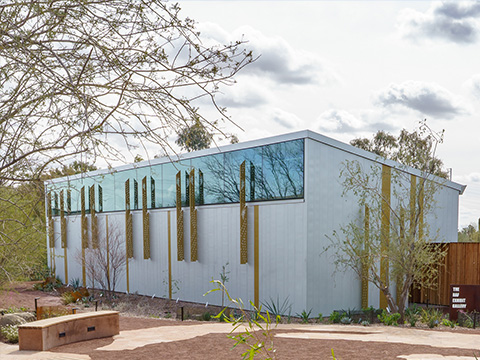
2025
The RAF Exhibit Gallery: a unique space for plant-focused exhibitions and events.
